|
Student and young consumer participation in Fast
helps reveal truth behind Publix's façade of falsehoods
Northeast Tour quickly approaching!
Chipotle's "Fair Food Fail" (CIW, 3/28)
It's not 1996 anymore... On violence in the fields, dehumanization, and Publix (CIW, 3/25) |
Media highlights...
Chipotle refuses to sign popular farmworker protection agreement (Triple Pundit, 4/2)
Letters to the editor, letters to Publix piling up in wake of fast (CIW, 3/30)
Publix and tomato growers (Lakeland Ledger, 3/27)
Pressing grocery chains, Fla farmworkers start to feel gains (Labor Notes, 3/22)
Publix should join others and pay extra penny for tomatoes (Orlando Sentinel, 3/13)
Fasting to support the rights of workers (Emory Wheel, 3/6)
and more... |
April 6, 2012 — One month ago today, over 60 farmworkers and allies were in their second day of a 6-day fast outside Publix corporate headquarters, demanding that Publix recognize farmworkers' humanity and help end the abuses that have plagued Florida's fields for far too long. Since then, coverage of the Campaign for Fair Food has been hot and heavy! Check out the CIW site for a sampling.
The fast was immensely transformative. Through reflection and action, farmworkers and allies demonstrated the strength of a committed group willing to sacrifice for justice.
Fasters were transformed from a loose assortment of workers and allies on Sunday evening to an inseparable family by the following Saturday and had made a strong (and increasingly well-received) moral appeal to Publix employees for a change of heart.
And while it may have taken the moral power of the fast to finally inspire members of the media to press Publix a bit more on the lies and obfuscation it has used for over a year to respond to the Campaign for Fair Food, students and other young consumers — future (and increasingly former, perhaps to never return again) Publix customers — saw through the lies long ago.
From the strong showings of support for the campaign from the leadership of several Florida campuses over the past years to the participation of students from the University of Florida and across the state and the southeast in the Fast to (perhaps most inspiringly) the growing commitment of young Lakeland'ers themselves to buck the company town mentality and call on Publix to be the corporation it claims to be, all indications are that the Campaign for Fair Food is alive and well in the hearts of Florida's young people of conscience who will continue to fight, as long as it takes, until Publix does the right thing.
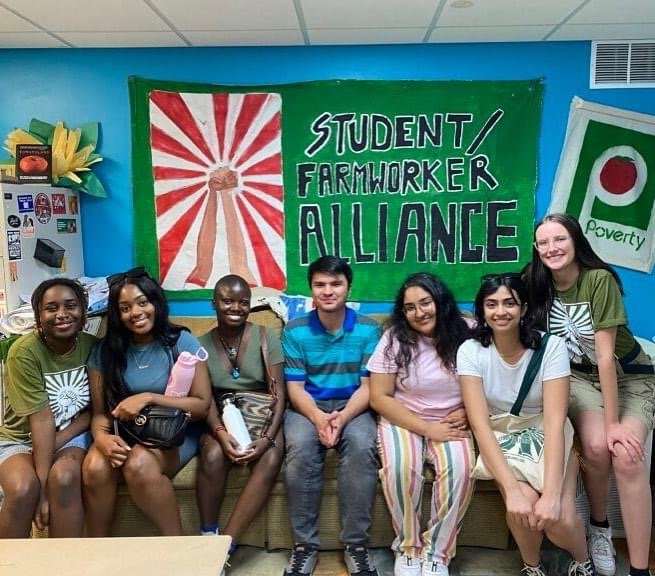
Among the Lakeland students foregoing food or lending support were Cristina; a native Lakelander, graduate of George Jenkins High School and current USF student; Emily, who grew up minutes from Publix HQ and fasted all week with the workers from Immokalee, Jesse and Pablo of Polk State College SWER (pictured below), and Pablo's entire family.

Although they could not be on-site all week as Emily was, Jesse and Pablo both fasted all week while attending class at PSC and visited the fast site when they could.
Even beyond the Southeastern reaches of the Publix empire, students are taking note of the company's inexplicable obstinacy. And not just any students.... Business students! 149 students from the MBA Evening Program, Classes of 2012 and 2013, at Georgetown University's McDonough School of Business penned a strong letter to Publix CEO Ed Crenshaw which states, in part,
We encourage you to live up to the admirable commitment in your mission statement by joining with other food industry leaders—Whole Foods, Trader Joe’s, and many others—in pledging to purchase only ethically grown tomatoes. Specifically, we urge you to use only suppliers who adhere to the CIW code of conduct and implement an additional penny per pound premium for farmworkers. As consumers, we would gladly pay a small premium to know that the same workers who feed us will earn enough to feed their own families. As future business leaders, we aspire to work for companies that demonstrate the highest ethical principles in their treatment of employees, suppliers, and customers. read more
Email Publix executives - demand they do the right thing!
The silence of Publix is insulting. The lies that Publix tells
every day shame the corporation.
— The Rev. Michael Livingston
The fact of the matter is they are not willing to voluntarily pay that penny
as other corporate buyers have done to rectify this historic injustice
to the people who put the food on our tables.
— Hon. Laura Safer Espinoza, Fair Food Standards Council
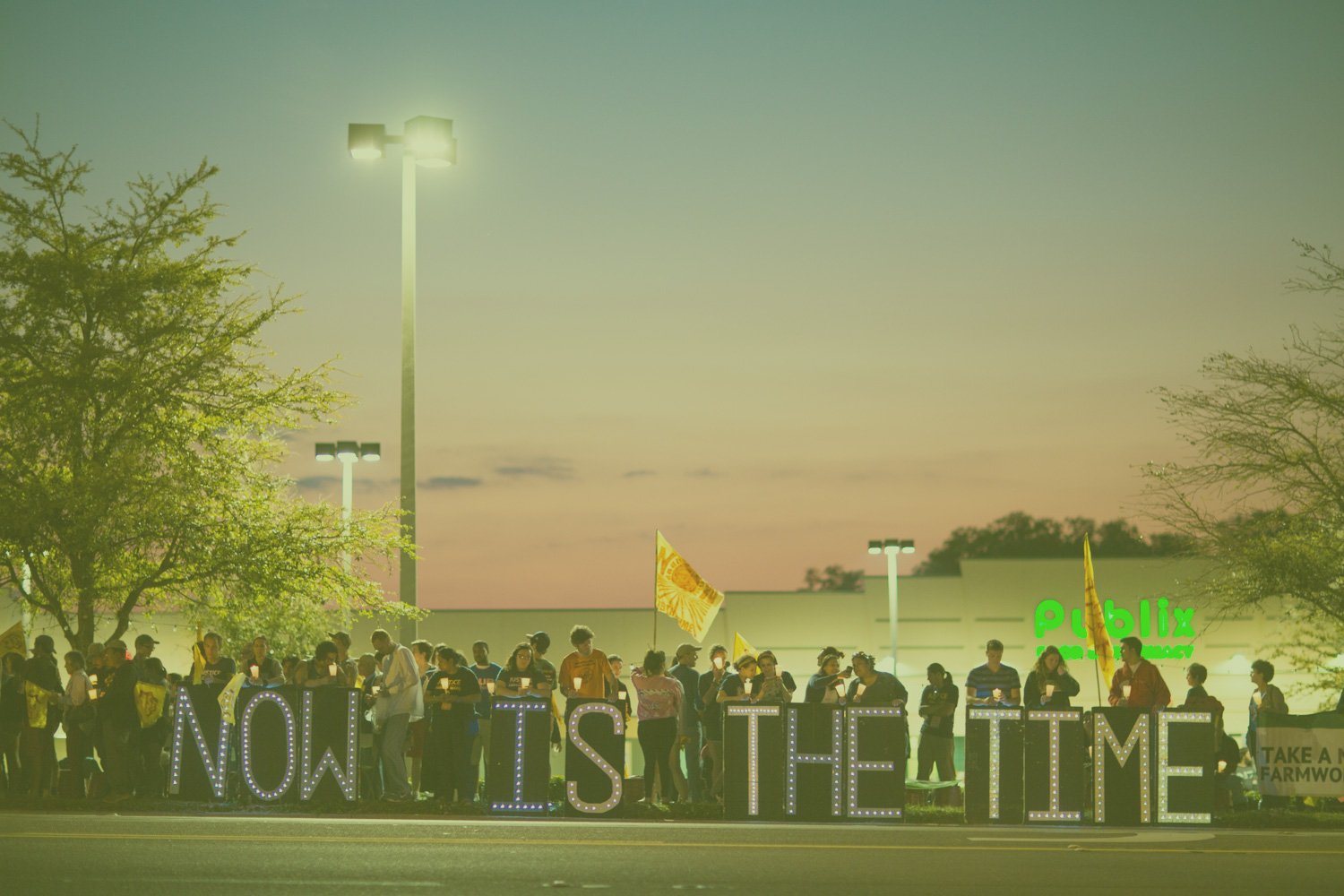
The Fast for Fair Food came to a close this past Saturday in a moving ceremony where over 60 farmworker and ally fasters broke bread with the help of Ethel and Kerry Kennedy and nearly 1,000 of their closest Fair Food friends who led a reflective 3-mile procession to Publix headquarters on their way to greet the fasters.
There is no way we could, in this email, do the fast, its beauty and power, and its impact on the Campaign for Fair Food any justice. There's no way we can put it any better than it was already put by mothers from Immokalee who sacrifice every day under unimaginable circumstances to provide for and give life to their families; there's no way we can improve on the words of the dozens of clergy and faith leaders who accompanied the fasters through the course of the week and saw with their own eyes the fear and disdain that prevents Publix from looking farmworkers and their allies in the eye.
One
of the immediate outcomes of the fast has been that Publix's year-long disinformation campaign about the CIW and the Fair Food Program has finally been put to rest; that what the CIW has been pointing out for a year now is finally out in the journalistic record. Publix will no longer be able to repeat that the Fair Food Program is a "labor dispute" or that it won't "pay employees of another company" or that its "would pay the penny if it was in the price." The moral basis for Publix to say these things never existed; their unchallenged repetition by reporters is gone now too.
Publix, it's time to put away childish things.
From the Tampa Bay Times...
As much as I appreciate Publix's response to my questions, I believe the company is disingenuous when it accuses the CIW of asking it to pay the employees of other employers directly...
"Not only does the Fair Food program not require what Publix is claiming, it does not allow it," Reyes said. "The fair food premium works like a fair trade premium does. And Publix pays and promotes that on every bag of its Greenwise Fair Trade Coffee. Tomato retail buyers pay a small premium to the grower on every pound of tomatoes they buy through the Fair Food program. The growers then distribute that money to their workers through their regular payroll as a line item on each worker's paycheck.
"Publix says they would pay the fair food premium if the growers would only 'put it in the price.' Well, they should consider their bluff called. The growers will put the premium in the price for any retailer who wants that, and we would sign a fair food agreement today with Publix stating they can pay that way if that is what they want." read more |
...And the Fort Myers News-Press...
But, said Laura Safer Espinoza, executive director of the Fair Food Standards Council, a nonprofit that oversees the Fair Food Program, the extra money is indeed built into the price. What’s more, the coalition has never asked Publix to pay workers directly.
McDonald’s, Sodexo and Whole Foods all pay for tomatoes as they always have, except now they pay the premium as well.
Growers pay workers except workers now get the bonus as well.
Every one of those buyers is doing what Publix says it’s willing to do, said Safer Espinoza; the heart of the matter is choice.
“Buyers have joined the program in response to appeals to conscience and with the support of their consumers,” she said.
“They have made the choice to pay the extra penny and they do so knowing they are not paying someone else’s employee.” read more |
...The AP...
The farmworkers want Publix to pay growers a penny more per pound of tomatoes, which would be passed on to pickers. The Coalition of Immokalee Workers' penny campaign has won support in recent years from companies like Taco Bell, McDonald's and Burger King.
Those companies and even the growers initially balked, but eventually signed a deal paying more. Publix says it doesn't set prices and growers should add the increase to what they charge for their tomatoes...
"We will not pay employees of other companies directly for their labor," Publix spokeswoman Shannon Patten said. "That is the responsibility of their employers."
Laura Safer Espinoza, a former New York State judge and director of the Fair Food Standards Council, said none of the corporate buyers participating in the program pay a farmworker directly.
"It's folded into the price and eventually passed down to the grower, who then pays the workers," she said. "The fact of the matter is they are not willing to voluntarily pay that penny as other corporate buyers have done to rectify this historic injustice to the people who put the food on our tables." read more |
...The Orlando Sentinel...
Carrying signs that read "Publix: Recognize farmworkers' humanity," the marchers walked three miles from a Publix supermarket to the company's headquarters.
There they met up with about 60 people, many of them farmworkers, who had gone six days without food in protest.
In a statement, Publix said it was more than willing to pay more but isn't in the habit of paying the workers of other companies directly.
But one of the attendees— former New York State Supreme Court Judge Laura Safer Espinoza — said Saturday that the company's response is disingenuous.
"No corporate buyer pays a farmworker directly. They pay the sellers, and that premium gets passed down the supply chain to the workers," said Espinoza, who is also the executive director of the Fair Food Standards Council, the independent compliance organization that monitors the corporate agreement.
Farmworkers are paid about 50 cents per bucket and to make minimum wage, they must pick more than two tons of tomatoes a day.
The extra penny, Espinoza said, is not going to push the worker up to middle class "but it is the different between suffering and not suffering."
The premium is folded into the purchase price that corporate buyers have agreed to pay participating growers.
"I'm assuming that [Publix] is saying that as long as they can purchase a cheaper tomato, that is what they are going to do," she said. "They are not willing to rectify a historic injustice to the people who pick the food we buy and put on our tables." read more |
...And summed up perhaps most succinctly by a longtime Publix customer,
Yet we're puzzled why such an upstanding, innovative, customer and employee friendly company would be uncooperative with tomato farmworkers. Approving a 1 cent fair wage compensation agreement to benefit low-wage tomato farmworkers goes against company policy and procedures?
It doesn't seem reasonable to my family that the details concerning the method used to ultimately benefit the farmworkers, at the bottom of the payments food chain, would be a significant enough issue to withhold approval. More so since 90 percent of the rest of the state's tomato buyers have already approved it according to the Sentinel. A Forbes Top 100 company to work for can't adjust to a new process. Really? read more |
We'll leave it at that for today. Of course, there's much more to come in the days and weeks ahead.
Our most sincere thanks go out to everyone who helped make the fast possible; sent in statements of support; fasted with us; and walked and broke bread with us on Saturday.

"...when people get caught up with that which is right and they are willing to sacrifice for it, there is no stopping point short of victory."
—Martin Luther King, Jr., "I've Been to the Mountaintop"
March 1 , 2012 — Last week, at a moving press conference just across the street from the University of Florida campus in Gainesville, three UF students declared that they will be joining workers from Immokalee in going without food for all 6 days of the Fast for Fair Food. Dozens of UF students—like their peers at schools across the state of Florida—plan to make the trek to Lakeland on Saturday, March 10th, for the culminating picket and procession to Publix headquarters and the ceremony to break the fast.
And today, from Nashville, comes a timely and moving, must-read reflection on why students are mobilziing for the Fast for Fair Food. Here's an excerpt:
After over two years of emails, petitions, letters, massive marches, and demonstrations, the farmworkers will turn to this most basic of arguments: we are real people, with vulnerable bodies that do not deserve the abuse they receive. And we are fiercely committed...
Meanwhile, a parallel story is taking place. Because the fierce commitment doesn’t end with the farmworkers. Hundreds of others, who have perhaps never seen a tomato field, will be supporting and fasting with them, there and in solidarity actions around the country. A lot of them will be students and young people, like myself, organizing through the Student/Farmworker Alliance.
The work of the Coalition of Immokalee Workers moves us, and leaves us surprised. My generation was trained to think solidarity like this can’t happen. We were raised to be cynics. Unlike those born in earlier generations, we have pretty much always known that the dominant message about our food — beaming at us from cereal boxes and billboards — is a lie. We’re aware that advertising is a Wizard of Oz light show, only what’s behind the curtain isn’t a funny old man, it’s a sweatshop.
The trick works because it meets our yearning for a sort of family. Advertisements teach us that ready-made rice brings three generations together for Sunday dinner, organic yogurt brings you back to the farm, and food corporations use friendly first names and build for us a family...
But if the CIW can marshal hundreds of supporters around the country for their Fast for Fair Food, it is perhaps because they’re also offering consumers that connection. Their popularity suggests that in the face of corporate seduction, we maintain our authenticity not through disengagement, but engagement. Contact, not dropping out. Because the ones who bring us food are family, in a way... read more |
The Fast for Fair Food begins in just a matter of days. We will go without food because we have had enough. We have had enough lies, dishonesty and stubborness from Publix. We have had enough of the tired, misleading PR statements mindlessly repeated by Publix spokespeople. We demand that Publix recognize the humanity of farmworkers and respect the intelligence of its own consumers.
We go without food because we must. We must ensure that Florida's largest corporation stops setting a horrible example for the rest of the supermarket industry and instead commits its formidabble size, power, resources and influence to the Fair Food Program, an unprecedented partnership resulting from nearly two decades of ceaseless struggle by farmworkers and their allies in the hopes of carving out from the shameful history of southern agriculture a new reality of deep and lasting dignity, respect and social responsibility.
We will not be moved. In the words of Raj Patel, we will be confronting Publix "with compassion:" ...The fast can’t succeed unless Publix recognizes the humanity of the workers in Immokalee. And that is the great strength of this fast: it works not by embarrassing a shameless Fortune 500 company, but by reminding the people who work there that they too are human, are capable of compassion, and of making change that is life-affirming...
We are tired of waiting on Publix to make change that is life-affirming. We intend to bring that change about, whatever it takes. It is shameful that Florida's quintessential corporation has missed the bus, has been a follower and not a leader in safeguarding the rights of Florida's farmworkers. Publix has no reason nor justification for its bullheadedness. This change must come.
JOIN US as we make history together; JOIN US for the Fast for Fair Food!
|